
Cognitive development
Field studying how children's cognition emerges and matures.

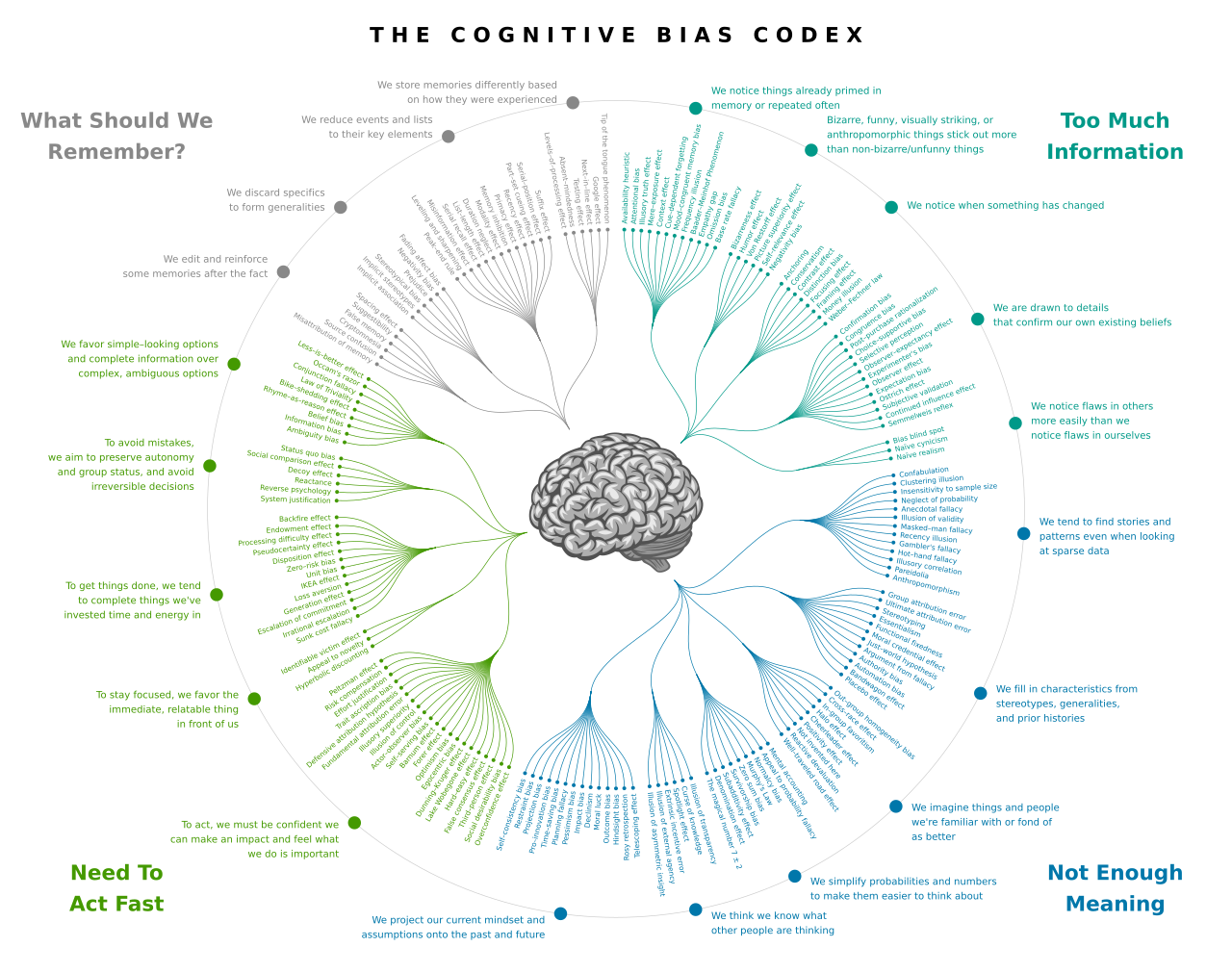
design: John Manoogian III categories and descriptions: Buster Benson implementa · CC BY-SA 4.0
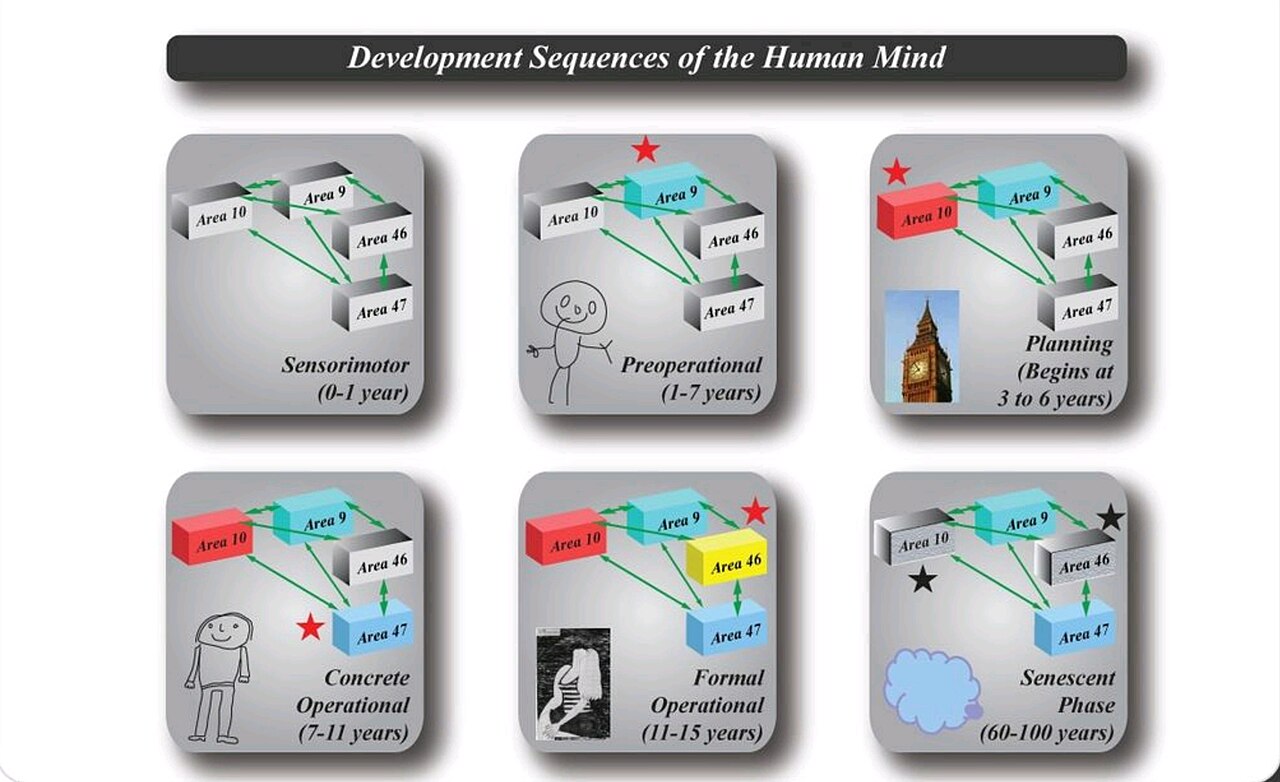
Cognitive development is a field of study in neuroscience and psychology focusing on a child's development in terms of information processing, conceptual resources, perceptual skill, language learning, and other aspects of the developed adult brain and cognitive psychology. It is defined as the emergence of the ability to consciously cognize, understand, and articulate their understanding in adult terms, and is described in terms of four key components: reasoning, intelligence, language, and memory. Jean Piaget was a major force establishing this field, forming his 'theory of cognitive development' with four stages: sensorimotor, preoperational, concrete operational, and formal operational period.
- field
- Neuroscience and psychology
- known_for
- Theory of cognitive development (four stages: sensorimotor, preoperational, concrete operational, formal operational)
Lore & Background
Cognitive development is a field of study in neuroscience and psychology focusing on a child's development in terms of information processing, conceptual resources, perceptual skill, language learning, and other aspects of the developed adult brain and cognitive psychology. Qualitative differences between how a child processes their waking experience and how an adult processes their waking experience are acknowledged, such as object permanence, understanding of logical relations, and cause-effect reasoning in school-age children. Cognitive development is how a person perceives, thinks, and gains understanding of their world through the relations of genetic and learning factors. These aspects begin to develop around 18 months of age, as infants engage with their environment playing with toys, listening to their parents, watching television, and responding to various stimuli that capture their attention, all of which contribute to their cognitive growth. Jean Piaget was a major force establishing this field, forming his 'theory of cognitive development'. Piaget proposed four stages of cognitive development: the sensorimotor, preoperational, concrete operational, and formal operational period. Many of Piaget's theoretical claims have since fallen out of favor, but his description of the most prominent changes in cognition with age is generally still accepted today. In recent years, alternative models have been advanced, including information-processing theory, neo-Piagetian theories of cognitive development, theoretical cognitive neuroscience, and social-constructivist approaches. Another such model is Bronfenbrenner's Ecological Systems Theory. A major controversy in cognitive development has been 'nature versus nurture', though it is now recognized by most experts that this is a false dichotomy, with gene activity interacting with events and experiences in the environment from the earliest points in development.
Reader's Guide
Cognitive development is significant as a foundational field in neuroscience and psychology, systematically studying how children's information processing, conceptual resources, perceptual skill, and language learning evolve into adult cognition. Jean Piaget established the field with his four-stage theory, which, despite many of its claims falling out of favor, still provides a generally accepted description of the most prominent changes in cognition with age—such as the shift from concrete, external actions to abstract understanding of observable aspects of reality, usually starting in adolescence. The field's legacy includes the recognition that cognitive development emerges from the interaction of genetic and learning factors, resolving the nature versus nurture debate as a false dichotomy. Alternative models like information-processing theory, neo-Piagetian theories, and Bronfenbrenner's Ecological Systems Theory have expanded understanding. The field also encompasses historical contributions from figures such as Jean-Jacques Rousseau, James Sully, Sigmund Freud, Maria Montessori, Arnold Gesell, Erik Erikson, Lawrence Kohlberg, and Lev Vygotsky, each offering different perspectives on developmental stages, social learning, and environmental contexts. The ongoing controversy about whether cognitive development is mainly determined by innate qualities or personal experiences remains in progress, with arguments from comparative psychology, molecular biology, and neuroscience supporting an ecological component in launching cognition.
Did You Know?
- Cognitive development is defined as the emergence of the ability to consciously cognize, understand, and articulate their understanding in adult terms.
- Jean Piaget proposed four stages of cognitive development: sensorimotor, preoperational, concrete operational, and formal operational period.
- A major controversy in cognitive development has been 'nature versus nurture', but it is now recognized by most experts as a false dichotomy.
- The essential issue in beginning cognition is how the nervous system grasps perception and shapes intentionality in the sensorimotor stage when organisms only demonstrate simple reflexes.
Philosophical Roots and the Mind-Body Question
The intellectual groundwork for cognitive psychology stretches back millennia. As early as 387 BCE, Plato proposed that the brain served as the locus of mental activity, an idea that would echo through centuries of philosophical inquiry. In 1637, René Descartes advanced the notion that humans possess innate ideas and articulated mind-body dualism—the view that mind and body constitute two fundamentally separate substances. These positions ignited a prolonged debate that persisted well into the nineteenth century: whether human thought arises exclusively from experience (empiricism) or incorporates knowledge we are born with (nativism). Thinkers such as George Berkeley and John Locke championed the experiential side, while Immanuel Kant argued for innate structures of understanding. The mid-to-late nineteenth century also witnessed landmark neurological discoveries that would later prove vital to cognitive psychology. Paul Broca identified the brain region largely governing language production, and Carl Wernicke pinpointed the area chiefly responsible for language comprehension. Damage to these regions, whether from trauma or malformation, produces what we now call Broca's aphasia and Wernicke's aphasia—conditions that gave concrete, observable evidence that specific mental functions are anchored in specific brain tissue.
The Cognitive Revolution and Institutional Birth
For roughly three decades spanning the 1920s through the 1950s, behaviorism dominated psychological research, treating thoughts, attention, and consciousness as unobservable and therefore outside legitimate scientific inquiry. The paradigm shifted dramatically in the late 1950s. Noam Chomsky's 1959 critique of behaviorism and empiricism is widely credited with igniting what became known as the cognitive revolution. Around the same period, J. S. Bruner, J. J. Goodnow, and G. A. Austin published A Study of Thinking in 1956, while G. A. Miller, E. Galanter, and K. Pribram followed with Plans and the Structure of Behavior in 1960. That same year, Bruner and Miller established the Harvard Center for Cognitive Studies, a move that institutionalized the new approach and helped launch the broader field of cognitive science. Formal recognition continued to build: George Mandler founded the Center for Human Information Processing in 1964. The field's identity crystallized when Ulric Neisser published his landmark 1967 book, which placed the very term cognitive psychology into widespread academic use and offered a sweeping definition of cognition as every process by which sensory input is transformed, stored, recovered, and deployed.
Wartime Urgency and the Computer Metaphor
Two external pressures in the mid-twentieth century accelerated the emergence of cognitive psychology as a distinct discipline. The first was military. World War II brought new technologies that demanded a deeper understanding of human performance under pressure—how to train soldiers effectively, how attention functions during combat stress. Behaviorism offered little practical guidance for these questions. Donald Broadbent stepped in, weaving together human performance research with the newly developed field of information theory to forge a more useful framework. The second pressure came from computer science. As machines grew more sophisticated, researchers began drawing parallels between computational processing and human thought. Allen Newell and Herbert Simon devoted years to developing artificial intelligence and later collaborated with cognitive psychologists to explore what their work implied for understanding the mind. This computational lens encouraged a view of mental functions—particularly memory storage and retrieval—modeled on the way computers process information, opening a doorway that behaviorism had simply left closed.
Scope, Definition, and the Architecture of Memory
What exactly does cognitive psychology study? Ulric Neisser's influential definition frames cognition as encompassing every process through which sensory input is transformed, reduced, elaborated, stored, recovered, and used—even when no external stimulus is present, as in imagery or hallucination. By this broad standard, virtually every psychological phenomenon can be read through a cognitive lens, though Neisser acknowledged that other viewpoints, such as dynamic psychology's focus on motives and goals, remain equally valid. Within this vast territory, memory occupies a central role, typically described in three stages: sensory memory, which briefly holds incoming sensory information; short-term memory, which temporarily retains information for active analysis while also retrieving material from longer storage; and long-term memory, which preserves information over extended periods and receives content from the short-term system. Beyond psychology's borders, cognitive research has been absorbed into linguistics, economics, and the interdisciplinary field of cognitive science, while earlier pioneers like Carl Jung, whose 1921 work on psychological types predated much of the behaviorist literature, and Jean Piaget, who studied children's and adults' thinking from the 1920s into the 1980s, laid groundwork the field now builds upon.
Gallery

Frequently Asked Questions
Who is Cognitive development?
Cognitive development is a branch of neuroscience and psychology that tracks how a child's mind matures from infancy through adulthood. It covers the emergence of reasoning, language, memory, and intelligence as interconnected milestones rather than isolated traits.
What are Cognitive development's powers/role?
Its core role is mapping how information processing, perceptual skills, and conceptual resources build layer by layer across childhood. It breaks this progression into four named stages: sensorimotor, preoperational, concrete operational, and formal operational.
How does Cognitive development's story end?
The narrative reaches its conclusion at the formal operational stage, where an individual can think abstractly, reason hypothetically, and articulate understanding in fully adult terms. Beyond that point the field shifts focus toward adult cognitive psychology rather than further developmental change.
Why is Cognitive development important?
It gives educators, clinicians, and parents a structured framework for understanding what a child can realistically comprehend at any given age. Misjudging a child's stage can lead to unrealistic expectations or missed intervention windows, making this field central to both psychology and public health.
Who created Cognitive development?
Jean Piaget is widely credited with establishing the field through his stage-based theory of how children actively construct knowledge. His early-to-mid twentieth-century work laid the groundwork that modern neuroscience and developmental psychology still build upon.
More in Mental Health & Psychology 1-20
Spotted an error? Know more?
This is a living reference — every entry is fact-audited, and reader corrections feed straight into our audit queue. Suggest an edit · See this site's audit record